UK licence and trust check – verified 24 September 2026
BetNjet UK licence, trust and player protection
 Available in GB
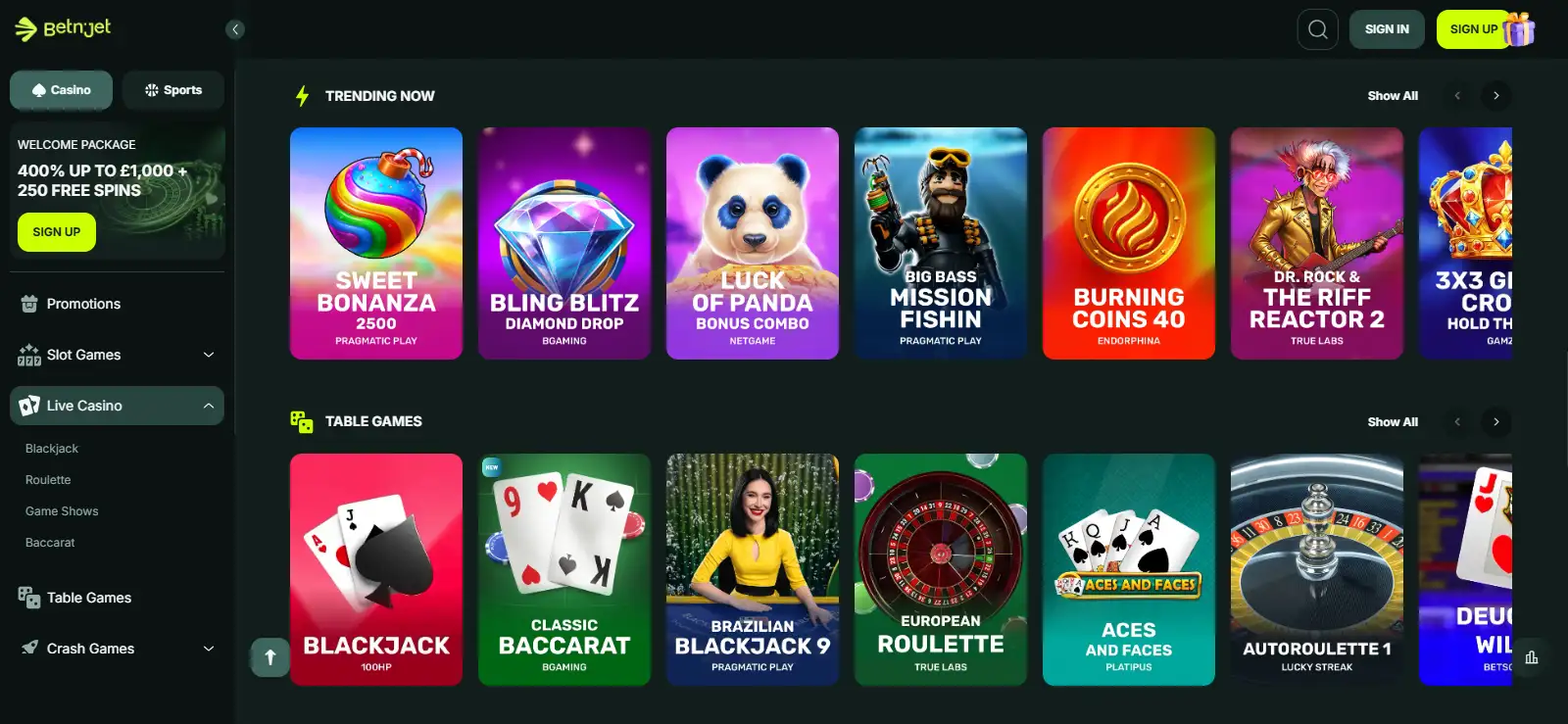
No BetNjet licence was verified in the UK Gambling Commission public register during the 24 September 2026 check. That matters because operators providing remote gambling facilities to consumers in Great Britain require the relevant Gambling Commission operating licence. BetNjet’s UK-English presentation and GBP support are separate product facts and do not establish a UKGC licence.
This page therefore uses the regulator register as the starting point rather than assigning a subjective safety score. It explains what a verified Great Britain licence would normally connect to, including the UKGC framework and GAMSTOP, and why those protections should not be attributed to BetNjet without a register match.
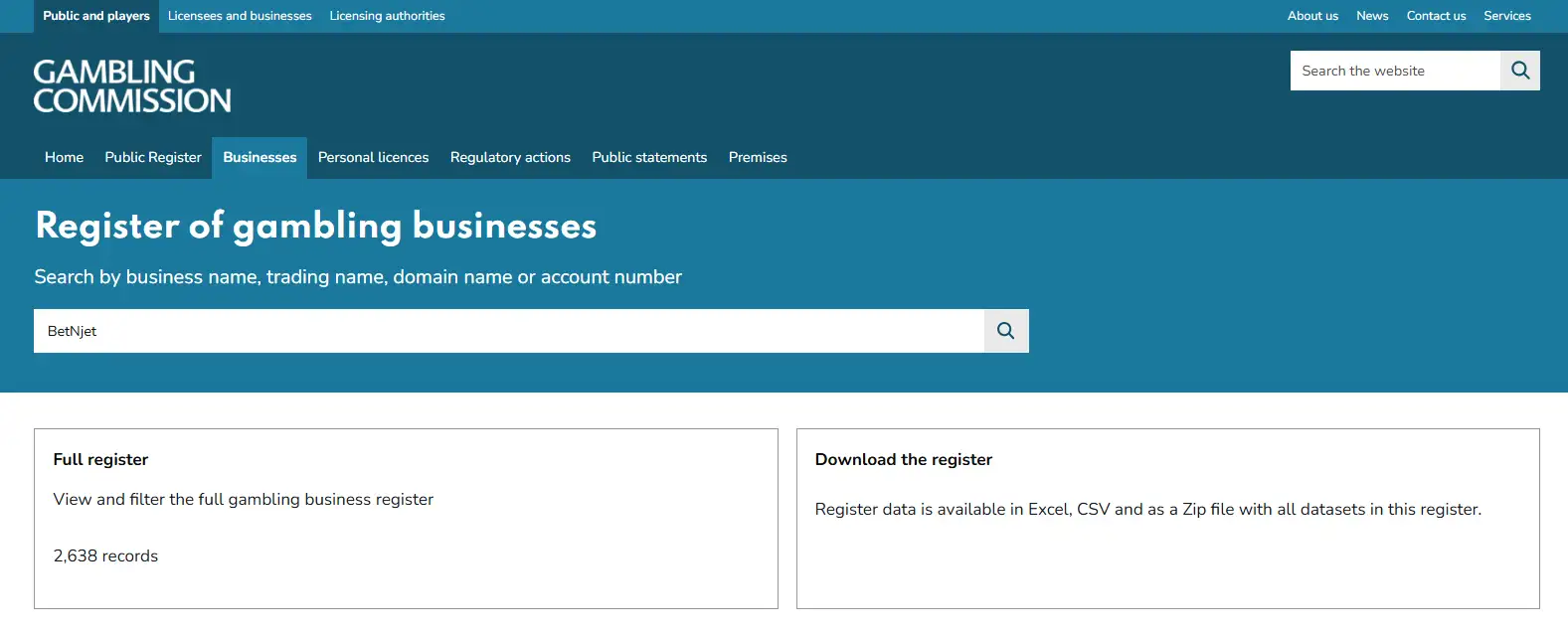
Table of Contents
- UKGC register result for BetNjet
- Why a Great Britain remote licence matters
- Great Britain is not the same legal label as the whole UK
- What a UKGC licence would normally connect to
- GAMSTOP coverage follows Great Britain licensing
- What the visible restricted-country list does and does not prove
- Trust checks that are stronger than a review score
- How to read user reviews without turning allegations into facts
- What this page can verify and what it cannot
- What the missing UKGC licence means when assessing BetNjet
UKGC register result for BetNjet
The Gambling Commission’s public register can be searched by business name, trading name, domain name or account number. The register page was listed as updated on 24 September 2026. A check for BetNjet and betnjet.com did not produce a verified matching licence entry, so this guide records the local licence outcome as no local licence verified.
That wording is deliberate. It does not claim that BetNjet has never held any licence anywhere, and it does not convert a missing Great Britain register match into a broad legal finding about every jurisdiction. It simply answers the page’s primary question: no matching BetNjet UKGC licence was found in the current public register.
Readers can inspect the Gambling Commission business register directly. The register itself explains that it contains business, trading-name and domain information supplied for licensed businesses, together with licence status and associated records.
Why a Great Britain remote licence matters
The Gambling Commission states that a business providing remote gambling facilities to consumers in Great Britain needs the relevant operating licence. Its remote casino guidance is equally direct: regardless of where an operator is based, a licence is needed when remote gambling is provided to consumers in Great Britain.
This requirement is about the regulated activity and the consumers served, not about whether a website uses English, displays pounds sterling or has a route labelled for the UK. Those presentation choices can help users understand a product, but they are not substitutes for a regulator-issued operating licence. That is why product localisation and regulatory status should be assessed separately.
The practical result is that a reader should not infer UKGC supervision from the presence of a GBP cashier, English pages or familiar payment methods. Those facts can be discussed on their own merits in the BetNjet payment methods, while the licence question remains tied to regulator evidence.
Great Britain is not the same legal label as the whole UK
Licensing guidance in this area is commonly framed around Great Britain, meaning England, Scotland and Wales. The wider United Kingdom also includes Northern Ireland, where the legal framework has separate nuances. A careful review therefore should not use “UK” and “Great Britain” as though they were identical legal territories.
For a UK-facing review, the simplest accurate approach is to say that the Gambling Commission regulates remote gambling offered to consumers in Great Britain and that the relevant operating licence is required for that activity. Northern Ireland should not be silently folded into every Great Britain statement. This distinction is especially important when a page is discussing regulatory protections rather than general site language or currency.
What a UKGC licence would normally connect to
A verified Great Britain operating licence is more than a badge in a footer. It places an operator within the Gambling Commission’s licensing framework and the licence conditions that apply to the licensed activity. It also gives readers a regulator record they can inspect for the licensee name, status, activities and declared domains or trading names.
For BetNjet, this review does not have that verified register link. As a result, it does not state that BetNjet is supervised by the Gambling Commission, covered by UKGC consumer-protection mechanisms, or compliant with UKGC licence conditions and technical standards. Those are claims that require a verified licence relationship, not just a UK-facing web route.
This is also why the site avoids claims such as “UK regulated” or “UKGC approved” for BetNjet. The evidence supports a narrower and more useful statement: no UKGC licence was verified in the public-register check carried out for this review.
GAMSTOP coverage follows Great Britain licensing
GAMSTOP states that all online gambling companies licensed in Great Britain must participate in its online self-exclusion scheme. Once a person is registered, participating operators check the person’s details when they try to register or log in and block access where the self-exclusion matches.
That does not justify saying that BetNjet is covered by GAMSTOP. The scope of GAMSTOP is tied to companies licensed in Great Britain, while this review did not verify a BetNjet UKGC licence. Without that licence link, assigning GAMSTOP coverage to BetNjet would go beyond the evidence.
For readers who use self-exclusion tools, that distinction is practical rather than technical. A site being available in English or showing GBP does not itself prove that it participates in the national online self-exclusion scheme. GAMSTOP’s own material should be the reference point for which licensed companies fall within its coverage.
What the visible restricted-country list does and does not prove
BetNjet’s reviewed terms included a visible restricted-country list in which the United Kingdom was not named. That is relevant to the site’s own published restriction wording, but it does not establish a Great Britain operating licence. The two facts answer different questions.
A country not appearing in a restricted list may indicate that the operator’s visible terms do not expressly list that country among the stated exclusions. It does not prove that the operator holds every local regulatory permission needed to provide gambling services there. Conversely, the absence of a UKGC register match does not automatically establish a universal account ban. This is why stated country restrictions and the licence check should be assessed separately.
The useful takeaway is not to collapse all of these signals into one “available” or “unavailable” label. For trust analysis, the stronger evidence is the regulator register when the question is local licensing, the operator’s own terms when the question is its stated country restrictions, and the live cashier or account flow when the question is a particular product feature.
Trust checks that are stronger than a review score
A practical trust check should begin with evidence that can be independently inspected. For BetNjet, that means checking the UKGC register, reading current withdrawal conditions, understanding what identity verification can be requested, and keeping product features separate from regulatory claims. The BetNjet withdrawals covers the published withdrawal limits and process, while the BetNjet verification explains the current document and account-check framework.
| Trust question | Evidence used here | Current finding |
|---|---|---|
| Is a BetNjet UKGC licence verified? | UKGC public business register | No matching licence was verified on 24 September 2026. |
| Does BetNjet show UK-facing product signals? | UK-English route and GBP support shown by BetNjet | Yes, but these are product-localisation facts, not licence evidence. |
| Can UKGC protections be attributed to BetNjet? | Requires verified UKGC licence relationship | No such attribution is made in this review. |
| Can GAMSTOP coverage be attributed to BetNjet? | GAMSTOP coverage is tied to Great Britain-licensed online operators | No, not without a verified Great Britain licence connection. |
This framework avoids treating a star rating or a marketing claim as equivalent to a regulator record. It also makes future updates easier: if a licence entry appears later, the register evidence can be checked again and the page can be revised from a clearly documented baseline.
How to read user reviews without turning allegations into facts
User-review platforms can be useful for spotting themes that may deserve further checking, but individual complaints are not the same as verified findings. A complaint about support, withdrawal handling or account restrictions may describe a real customer experience, yet the circumstances cannot normally be established from the review text alone.
For that reason, this page does not reproduce individual allegations as claims about BetNjet and does not use them to override primary evidence. If a review raises a concern about payments, the better next step is to compare it with the published withdrawal rules and current account terms. If a review makes a licensing claim, the regulator register remains the stronger source.
This separation is important because reputation data changes quickly and can contain disputes, duplicate accounts or incomplete context. It can inform what to investigate, but the trust framework on this page remains anchored in regulator records and sourceable product rules.
What this page can verify and what it cannot
As of 24 September 2026, the page can verify that the Gambling Commission’s public register was current that day, that no BetNjet or betnjet.com licence match was verified in the check, and that the Commission requires the relevant operating licence for remote gambling supplied to consumers in Great Britain. It can also verify that GAMSTOP coverage is built around companies licensed in Great Britain.
It cannot turn those facts into a blanket statement that BetNjet is “legal” or “illegal” across the entire United Kingdom. Nor can it claim that a UKGC licence exists under an unidentified parent company without a register match that can be tied back to the BetNjet trading name or domain. The available public sources also leave the parent or legal operator identity unresolved, so this page does not fill that gap with a guessed company name.
That boundary is useful to readers because it separates what is known from what would require better evidence. If BetNjet later publishes a verifiable licence number, legal entity or regulator link, those details should be checked against the regulator itself before being added.
For the wider product picture, see the BetNjet UK review.
What the missing UKGC licence means when assessing BetNjet
The most important trust fact for a Great Britain reader is straightforward: no BetNjet UKGC licence was verified in the public-register check on 24 September 2026. The Gambling Commission says remote operators serving consumers in Great Britain require the relevant operating licence, so a UK-facing site presentation should not be mistaken for regulatory authorisation.
That does not erase independently verified product facts such as GBP support, games, payments or account features. It does change what protections this review can attribute to the brand. In particular, this guide does not describe BetNjet as UKGC regulated, covered by UKGC dispute-resolution structures, compliant with UKGC standards or protected by GAMSTOP. Readers comparing the site should weigh that regulatory gap separately from the product features described elsewhere in this guide.
Published by the Betnjet Casino team.